


Meta description: Data centers are reshaping raised access floor demand in 2026. Learn how panel core (calcium sulphate, steel cement, wood core, aluminum) and CISCA test reports help you pick a trustworthy factory.
The raised access floor (RAF) industry is having a decade-defining moment. Digital infrastructure — hyperscale data centers, cloud platforms, AI computing clusters and edge facilities — is pulling the entire category forward, and buyers who understand the product and the standards behind it are the ones who avoid costly mistakes. This article looks at the raised access floor market through a buyer’s eyes: where demand is coming from, what the four panel-core technologies really do, which test standards separate a reliable supplier from a gamble, and why buying directly from a factory changes the outcome.
The market is moving — and data centers are pulling it
Global demand for raised access flooring is growing steadily. The overall raised floor market was valued at around USD 3.89 billion in 2025 and is projected to reach USD 6.15 billion by 2034, a compound annual growth rate of roughly 5.2% (Strategic Revenue Insights, 2026). Within that, the data-center raised floor tile segment alone is expected to reach about USD 1.44 billion by 2032, growing at a CAGR of 6.0% (PW Consulting, 2026).
Data centers are the dominant end-user segment. Why? High-density IT needs a flexible underfloor that hides cabling, supports underfloor air distribution (UFAD) cooling, and lets you reconfigure without gutting the building. Cloud services, AI workloads and edge computing are pushing operators to prioritize raised floors that are energy-efficient, easy to upgrade and quick to maintain. Industry analysis attributes roughly 68% of demand growth to data-center infrastructure expansion, 54% to IT modernization, 49% to cloud adoption and 36% to government digitalization initiatives (Industry Research Co., 2026).
What does this mean for you as a buyer? Competition among suppliers is intensifying, and the difference between a floor that performs for 15 years and one that fails at year three often comes down to the panel core and the test evidence behind it.
From the buyer’s side: why panel core matters
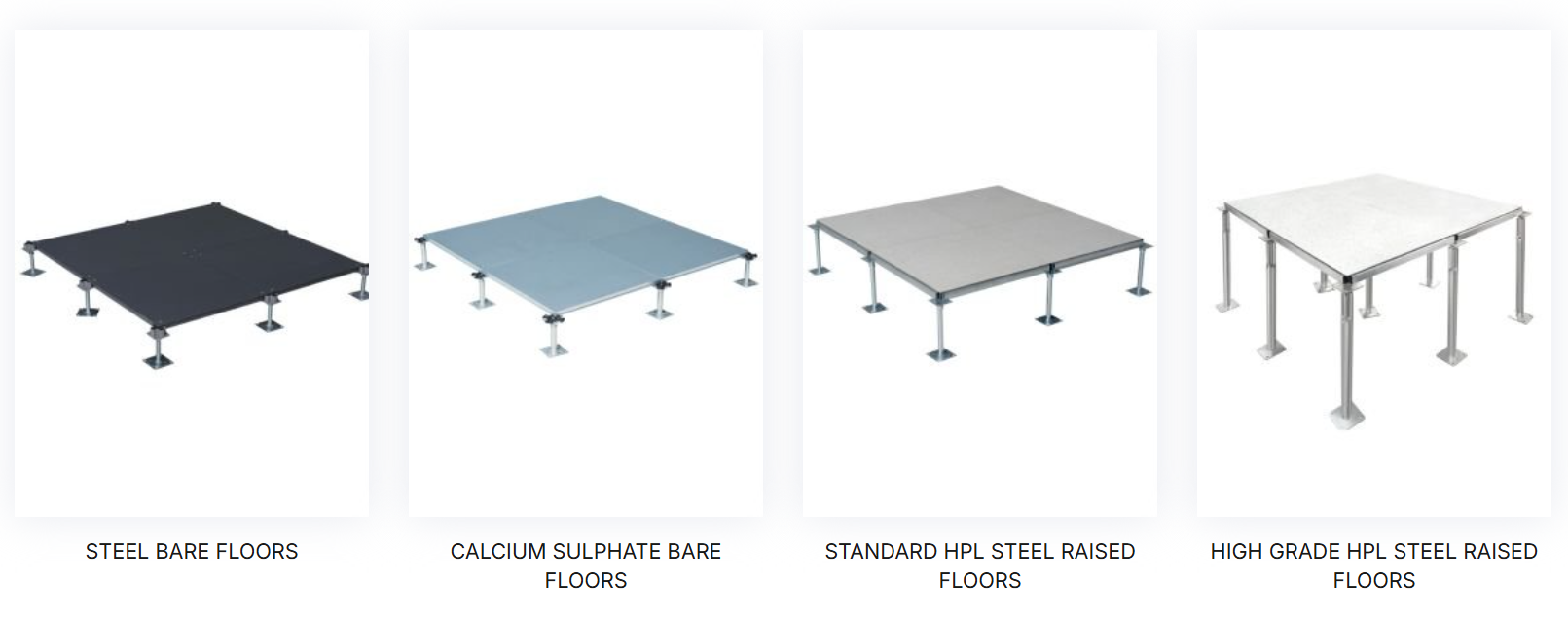
Every raised access floor system starts with the panel core. Four core technologies dominate the market, and each suits different loads, environments and budgets.
| Core type | What it is | Typical strengths | Best-fit use |
| Calcium sulphate board | A dense gypsum-based core, encapsulated in galvanized steel | High stiffness and load capacity, good flatness, stable under point loads | Data centers, technical rooms, high-load office zones |
| Steel-cement board | Steel shell filled with cement | Very high strength-to-weight performance, long life, handles heavy rolling loads | Warehouses, control rooms, high-traffic areas |
| Wood-core board | A wood core with laminate or steel skin | Lighter, cost-efficient, easy to cut on site | Commercial offices, showrooms, low-to-medium loads |
| Aluminum floor | Die-cast aluminum alloy panel | Lightweight, corrosion-resistant, excellent airflow control | Cleanrooms, labs, humid or coastal environments |
As a factory that runs production lines across all four cores — calcium sulphate, aluminum, steel-cement and wood-core — HIMOR designs the panel to the application rather than forcing one technology on every job. That breadth matters because a specifier’s needs vary: a server hall needs high point-load stiffness, while an office fit-out often needs a lighter, more economical panel.
Standards are your shortcut to quality: understand CISCA
This is where buyers separate professionals from amateurs. The Ceilings & Interior Systems Construction Association (CISCA), the U.S. industry body, publishes the “Recommended Test Procedures for Access Floors” — the de-facto benchmark that determines how a floor system is loaded and measured. The procedures cover concentrated loads, ultimate loads, rolling loads, stringer loads, pedestal axial loads and pedestal overturning moment loads. In practice, when a supplier says a panel “passes CISCA,” it means the product has been load-tested under these recognized procedures rather than on marketing claims.
The credibility of a claim rests on who did the testing. Reputable projects require test reports certified by an independent testing laboratory — not the factory grading its own homework. When you see third-party test reports plus CISCA-conforming procedures, you have objective evidence of load capacity, deflection and permanent set.
For buyers, the practical advice is simple: ask for the test report, check that the load ratings match your application, and confirm the testing body is independent. At HIMOR, all raised access floor products are tested to pass the CISCA test standards, backed by third-party test reports you can review before you order.

What “buying from a factory” really buys you
Many buyers source raised access floors through trading companies, which adds margin, lengthens lead times and blurs accountability. Buying directly from a manufacturer changes the economics:
- Single point of accountability. One team owns design, production, testing and delivery. If a panel doesn’t perform, there’s no intermediary to argue with.
- Production-line breadth. A real factory runs all four core technologies in-house — calcium sulphate board, aluminum floor, steel-cement board and wood-core board — so you can consolidate products, spares and after-sales in one order.
- Test evidence, not claims. A factory with third-party test reports and CISCA-conforming testing can hand you the documents that engineers and EPC contractors actually require.
- Capacity and stability. HIMOR operates a 150,000+ m² workshop with over 500 employees and around 1.7 million m² of annual floor-panel capacity, backed by 25 years of manufacturing experience. That scale means consistent quality, reliable volume and stable supply.
A practical pre-purchase checklist for raised floor buyers
- Match the core to the load. Point loads, rolling loads and fire requirements dictate the right core. Don’t over-spec or under-spec.
- Demand third-party test reports. Verify CISCA-conforming procedures and independent laboratory certification.
- Ask about the full system. Panels matter, but so do pedestals, stringers and edge details — a strong system is more than a strong tile.
- Verify factory credentials. Visit or audit the plant; check production lines, capacity and years of track record.
- Plan the total cost. Factor in freight, installation and lifecycle — the cheapest panel is rarely the cheapest floor.
The takeaway
Raised access flooring is growing because digital infrastructure is growing, and buyers who understand panel cores and test standards will source with confidence. Whether you need calcium sulphate panels for a data center, steel-cement boards for high-load environments, aluminum floors for cleanrooms, or wood-core panels for offices, buying from a factory with all four production lines and CISCA-conforming third-party test reports removes the guesswork. Talk to HIMOR about your project, review the test data, and choose a floor you can build on.
